
VOLUME 7
simple meter
This volume deals with binary measures in 2, 3 and 4 beats. Their common point is the division of beats, but they are very different from each other. Through a variety of exercises putting the whole body in motion, we discover the back and forth sensation of the 2-beat measure, the circular movement of the 3-beat measure, the duration – and therefore a greater use of space – induced by the 4-beat measure.
1. changing meter
This first track might seem difficult to access since it introduces changes of meters right away. But this is not the case: by its dancing style, it awakens the natural musical instinct and the flexibility to adapt to changes without requiring any theoretical knowledge or mastery of every type of simple meter.
- Follow the music and the different styles by moving on each beat (one movement or step for each beat), and adapt instinctively to the changes of measure.
- Dance with a partner: find dance steps using the heel and/or toes.
- Beat time in a musical way. Notice that the first sequence in 3/4 could also be perceived as compound measures (two measures at 3/4 equals one measure of 6/8).
The distinction between 3/4 and 6/8 is often quite subtle, as it depends on the melodic line, the bass line, the tempo, the rhythm or the harmonic accompaniment. In the Dalcrozian context of an intuitive approach to capture the spirit and movement of the music through one’s own sensitivity, the essential comes down to the sense of “roundness” in the groupings in 3, which makes you want to spin like in a waltz.
- Group the children in two for the measures of 2 beats, in three for the measures in 3 beats and in four for the measures of 4 beats. Attribute an activity or a gesture or a movement to each type of measure, perhaps with a material, for example, balls which are always very effective in feeling and responding to changes of measure.
- Another idea would be to group the class into three groups, each group corresponding to a type of meter. Each group reacts to the meter that concerns them by moving with a movement created and defined in advance, with or without material (ball, scarf, stick, etc.). Rotate the groups.
Children cannot be expected to respond correctly immediately to the changes of measures as there is an element of surprise in this track which is actually part of the game and the fun!
- For Dalcroze teachers, this track could lend itself to a typical hip/hop exercise (vocal signal), but for this to work, the teacher needs to be very familiar with the sequence of measure changes. The track starts in 2/4; hop! indicates a change to increase the number of beats in the measure (we go to 3/4 and maybe to 4/4); hip! indicates a reduction of a beat.
8 years and up
2. changing meter (repeated sequence)
The structure is: 8×4 beats, 8×3 beats, 8×2 beats, three times.
This piece lends itself to an awareness of space. One’s experience of the space and one’s manner of moving in space is quite different, according to the measure:
The measures at 4 beats suggest an exuberance of movement where the walk advances, “swallowing” the space.
The measures of 3 beats suggest moving in curved lines, as the sensation of 3 beats is round.
Those at 2 beats use less space and the movement would advance less.
The specificity of this piece is that the structure is clear and systematic so the students have time to prepare themselves for the changes of measure.
- Walk the beat, indicating the length of the bars either by alternating arm movements or by changing direction.
Group by four for the measures of 4 beats, one behind the other and advance in the space stepping the beats.
Group by three for the measures of 3 beats; hold hands to make a little circle and step 3 steps to the right, 3 steps to the left.
Two by two for the measures of 2 beats; invent a movement or a clapping game together.
- This piece could also lend itself to a ball game. Group the children by 4; they squat on the floor in the form of a square. Each child has a tennis ball.
Measures of 4 beats: roll the ball to the person diagonally opposite (only one diagonal at a time, alternating). Measures of 3 beats: roll the ball the person to one’s right.
Measures of 2 beats: roll the ball for oneself.
8 years and up
3. 4/4 playing with an ostinato rhythm bass-soprano
This piece has three sections of the same ostinato rhythm, each section separated by a transition in half notes. They serve to move the rhythm from the treble to the bass and vice versa. The first transition is twice as long as the second.
- Start as if in a warm up: move different parts of the body (discover each joint) with the rhythm.
- “Paint” the rhythm with dots (shorter values) and lines (longer values). One can choose to continue to do the rhythm during the half notes (during this first step, the focus is on the rhythm, but not necessarily on the high/low register).
- Step the half notes (bass) and clap the rhythm (treble); listen to the change, and when the rhythm is in the bass, do the opposite: step the rhythm and clap the half notes. In this stage, we will use the transitions of half notes to prepare the change of register (high/low – low/high).
The transitions of half notes might also be used either to clap/walk/move according to the note values heard, or to clap/walk/move the rhythm of the ostinato, or to create one’s own rhythms.
6 years and up
4. 3/4 beat and division
- Listen to the regular phrases of 4 measures each; to feel the articulation of the phrases and to give them a shape, do a waltz step three times (circular movement) and walk straight ahead (clear direction) for the three steps of the fourth measure.
- Step or clap the beats or the division, regardless of what the piano is doing (don’t necessarily follow the sequence of the piano). Fill the rests, keep on moving.
- Clap the downbeats, alternate with some rhythms of one or several measures.
- The students are in a circle. One person proposes a rhythm of 3 beats that the class imitates 3 times; then a new rhythm is proposed, again, the class claps it 3 times, etc. At the end of the music, there is a collection of several different rhythms of 1 measure each.
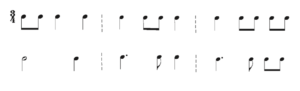
- Choose 4 rhythms and combine them in 4 measure phrases (or, even better, choose 3 rhythms and finish with a dotted half note). The rhythms need to remain simple, for example, use only eighth notes, quarter notes, dotted quarter notes, half notes or dotted half notes. They need to be adapted to the level of the class so that students can execute them with ease and musically.
Here is a selection of possibilities:
6 years old and up
5. four-beat measure
This track, staccato and modal, lends itself to various types of exercises developing imagination, a sense of pulsation, movement and body mapping, a sense of direction, a sense of rhythm and interaction with a partner.
- The children invent the gait of an imaginary character by walking to the beat of the music.
- In a circle, choose a part of the body to move. On the first beat, everyone does the same movement; the other three beats of the measure are free movements but with the same part of the body. (For example, we are moving our heads. On the first beat every child makes a movement of the head to look to the ceiling. They do the next three movements with their heads, as they wish). Change the body part.
- Imitate the angular style of the music, picking four points in space and “painting” them with a flick of the imaginary paintbrush, one sound = one flick. Repeat the same series of 4 orientations several times (it could be a square or any other kind of geometrical shape). Then, keep the 4 chosen directions but change the movement: do it with the eyes or by moving various parts of your body.
The teacher could choose one pupil to stand in front of the class and do his/her four movements. The class imitates in mirror.
- Walk/clap the quarter note beats, alternate with half notes, whole notes or eighth notes, according to the teacher’s instruction. Swing on the half notes forwards/backwards or sideways; find movements to associate with each note value.
- Using these note values, create your own rhythms that the whole class imitates, clapping or walking.
- With a partner: A = moves or claps on beats 1 and 3; B moves or claps on beats 2 and 4. Develop an interaction between A and B.
- Practice beating the four-beat measure.
5 years and up
6. dance piece in 2/4
This short two-beat piece highlights the simplicity of binary movements. The number “two” here represents both the number of beats in the measure and the binary division of the beats.
The feel of 2/4 is rather angular and inspires all sorts of actions: clapping a hammer, digging a hole, raking etc. Anatomically, each joint of the body lends itself to a flexion/extension movement (wrist, elbow, knees etc.) or an up/down movement (shoulders) or lateral movement (head).
The sensation of these back-and-forth movements contributes to the development of the body map.
- This piece lends itself to many stories: building a house or maintaining it, for example, where all actions can be performed to 2 beat music:
– sawing wood (horizontal back and forth movement)
– painting a wall (up-down action)
– hammering nails
– sweeping or vacuuming
– cleaning windows
– picking up toys etc.
- Based on the children’s ideas, choose a series of 4 “home” actions of 4 measures each to be memorized, respecting the chosen order. Invent a concluding movement adapted to the cadence which has only 3 measures of 2 beats.
These activities are for ages 4 and up. Even up to age 8, children enjoy exercises with a simple structure, as it gives them room to develop more elaborate ideas in terms of body skills and imagination.
- Other ideas:
– Pass a ball around in a circle.
– In the forest, point to the bird, squirrel, ant …
– In space, point with elbow, eyes, etc.
– 2 circles on the ground: put one foot in one, then the other in the other.
– Bounce the ball on the ground and catch it.
– Also use the 2/4 to move in space a) in a very short back and forth movement; b): walk by bending one leg, then the second step by straightening up (= down-lean-bend) /up-straight; c) find steps. Ex: side step, and bring the other leg back.
– Create a dance: lateral steps, individually / two by two for the cadence.
– Place bricks (cardboard or wood) on the floor about 20 cm apart. Walk the first beat on the brick and the second beat between the bricks (space management). This exercise is equally valid for 3-beat and 4-beat measures (just add the distance of one or two extra steps between the bricks).
These ideas can be done at different ages and should be adapted to the children’s motor skills.
4 years and up
7. slow walk
The principal difficulty one encounters when walking very slowly is to maintain balance. One can either take the first step, leaving the back foot on the floor until the very last moment, and then take the second step with this foot. This is probably how younger children would manage a very slow walk.
- To execute a slow walk in a more artistic way and develop a better balance: practice taking long steps by gradually moving the free leg forward to the next step in a continuous movement, which emphasizes the duration of the sounds and gives the movement a legato quality.
Express the nuances of the music by walking more or less heavily.
- Clap the slow beat of the music as is. Then divide the beats to clap two, then four times faster. Repeat using steps. Return to the slow tempo either with claps or with steps.
- Use this music track to practice the basic rhythms (anapest, dactylic, trochee, iamb, syncopation) and all the 4/4 rhythms studied in the previous volumes (especially volume 3).
7 years and up
8. interrupted canon in 3/4
- Listen to the music and notice the alternation between rhythmic active measures and passive ones (quarter notes only). The music begins on the first beat of a measure and the students repeat the rhythm during the “passive” measure that follows.
- Step the beats and beat time (measures of 3 beats). Internalize rhythm and melody by singing in one’s head (without voice) one measure later. The teacher can evaluate if it is easier for the class to step the beats or stay still to do this task.
- Step the beats and clap the rhythm one measure later.
- This time, instead of clapping the rhythm one measure later, step it.
8 years and up
9 . repeat the division
This track appears simple, but it lends itself to activities at various levels of complexity, from quite simple to quite elaborated. Its tempo is measured – andante tranquillo. In the midst of a regular beat of quarter notes we hear from time to time either a division in 2 or in 4. The objective is to hear the divisions and to differentiate between them. The students do this through a variety of activities which ask for a reaction on the beat after the division.
- In a circle the students clap the quarter notes and the divisions one beat later (being in a circle allows them to feel connected to the others).
- Then, do the same thing, and add stepping the quarter notes only (freely in the space).
- Finally, leave the clapping aside and step the quarter notes and the division one beat later.
This is an introductory activity to the Dalcroze canon exercises. These exercises may be used with older children, adolescents or even adults.
Here is a selection of activities for children from 4-5 years of age:
- Listen to the music together and help the children to be aware of the regular quarter note beats and the divisions. “Raise your hand/change position when there is a surprise”. “Is the surprise always the same?”
- Without music, the children clap quarter notes. The teacher says “2”! or “4”! on one beat, and the children clap the subdivision one beat later.
This activity allows children to practice immediacy and accuracy of response, before working with the music track.
- With the music: the children are in pairs. They clap together the quarter notes. One child claps the divisions in 2 and the other the divisions in 4 (one beat later). Change roles.
- Older children (6-7 years) will enjoy the following activity (after working with the above ones): the children are in pairs and walk the beats one behind the other. When the division into 2 is heard, they turn around; when the division into 4 is heard, the child behind runs in front of his/her partner.
5 years and up
10. changing meter
- Listen and feel the difference between the roundness of the three, the linear quality of the four and the rebound of the two.
- Firstly, isolate each meter (take a segment of the track); clap the strong beat while stepping all the beats; then try the opposite: step the downbeats only while clapping all the beats (more difficult!). Make the difference between 2/4 and 4/4 by listening carefully to the phrasing.
- Once each segment has been worked on separately, use the entire track: adapt as soon as possible to the changes of meter (at first, the teacher might help the students by calling the next meter one measure in advance).
2/4 = bounce a tennis ball (or bigger) and catch it on the second beat;
3/4 = roll the ball on the floor between the two hands, one rolling movement per measure; adapt the movement and use of space according to the time;
4/4 = hold the ball and move the arms forward and backward.
(Students must have already become used to playing with a ball).
- With a partner: same activities with interaction; 3/4 could also be: tap the partner’s ball on the first beat.
- Dance freely with the music and beat time.
One of the roles of improvisation in Dalcroze teaching is to alert students to changes, contrasts, etc. These musical cues are induced through modulation, rubato, etc.
In this piece, the musical warnings to the changes of measures are subtle. Unlike tracks 1 and 2 of the same volume which can be worked on instinctively and immediately, this piece must be prepared: to help students assimilate the piece of music, changes of meters could be announced by the teacher, allowing students to respond simultaneously (with the appropriate change of activity).
8 years and up
11. measures of four without division
- Feel the beats and meter by walking beats and changing direction every four notes (strong beat);
- Beat time and step beat (coordination); or stay in place and design the meter (one line per measure).
- Divide each beat in two and clap the division; do the same with the division in three.
*Same exercise by stepping the divisions (walking in groups of three is more difficult: it requires changing legs on each beat).
- A clapping exercise: divide class into three groups: 1 = beat, 2 = division in 2, 3 = division in three. The teacher leads all three groups: first several measures of each division and transition through quarter notes, then change directly between divisions, supported by the presence of quarter notes; change roles.
- Individually, walk the beats, clapping one (or more) measure(s) of division in two and one (or more) measure(s) of division in three.
- *Walk the divisions with the following structure: 4 simple time measures to look for a buddy and then 4 measures to walk the beats together (so whenever I am alone, I walk the divisions and when I am with a buddy, I walk the beats with him).
- Walk the beats freely and clap the divisions, simple or compound, changing division when the musical phrasing changes.
- In a circle, walk 4 beats forward and 4 beats back. Each in turn creates a rhythm on the 4 steps forward, and everyone repeats this rhythm on the 4 steps back. Do not mix simple and compound divisions.
- Create your own rhythms (in simple or compound time). Write a selection of these on the board – either one division or the other at a time – for the class to clap, according to the teacher’s direction (visual reaction).
- For more advanced students, the teacher could write a mixture of rhythms of simple and compound divisions.
* Given the tempo of the piece, the division by three will be easier to perform by clapping than by stepping. The teacher can have the students step the divisions by two, as the speed is appropriate.
For experienced children 8 years and up

